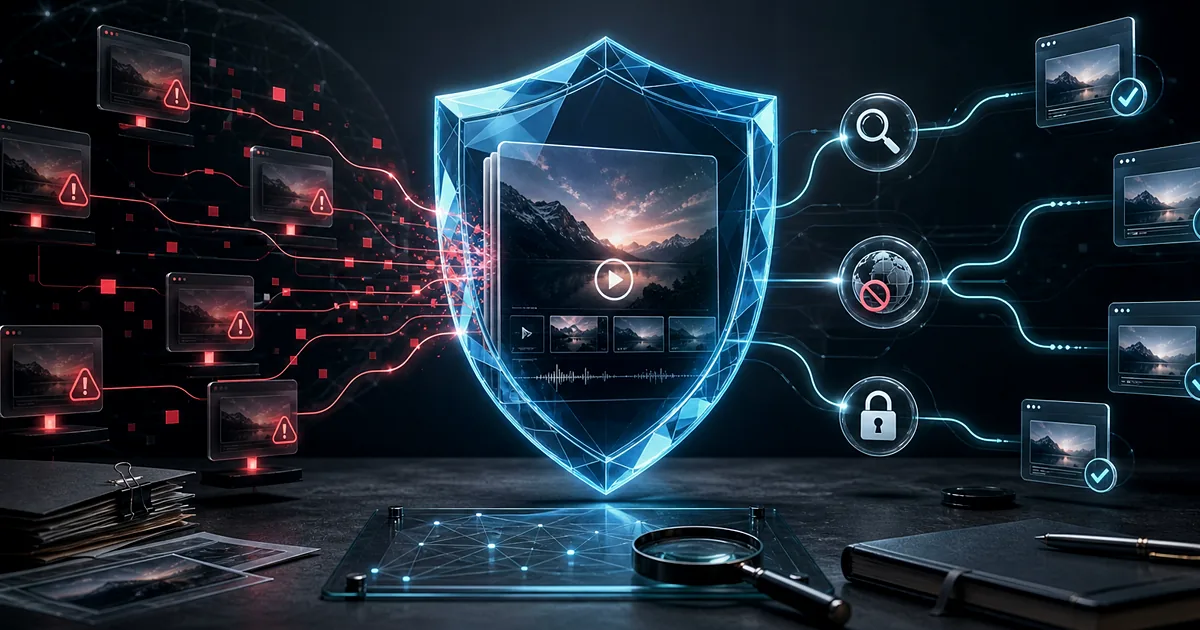
The practical choice between openDMCA and Bruqi starts with the abuse you need to stop. Bruqi's published terms cover public-web scanning, search-result delisting, content removal, deepfakes, and impersonated accounts for creators or managers. openDMCA is narrower by design: it concentrates on finding leaked creator content, routing valid takedown and search-removal requests, tracking outcomes, and monitoring for reuploads. Neither service can lawfully promise that every URL will disappear, because the host, platform, facts, jurisdiction, and any counter-notice remain outside a vendor's control.
The answer in one minute
Shortlist Bruqi if fake profiles, synthetic media, or manager-operated protection are first-class jobs alongside copyright enforcement. Shortlist openDMCA if your recurring problem is paid photos or videos being reposted across leak sites, forums, file hosts, and search results, and you want to scan a stage name before committing. Then test both with the same small evidence set. A feature list cannot tell you whether either scanner recognizes your aliases, whether its team understands the hosts affecting you, or whether the dashboard produces evidence you can audit.
| openDMCA | Bruqi | |
|---|---|---|
| Core operating model | Creator leak discovery, notices, delisting and reupload monitoring | AI-assisted scanning plus removal and delisting requests |
| Deepfake removal in published scope | Use the appropriate privacy, NCII or platform route case by case | Explicitly included in Bruqi's published service terms |
| Impersonated accounts | Handled where the applicable platform or legal route supports it | Explicitly included in Bruqi's published service terms |
| Manager use | Agency workflows for multiple creators | Terms explicitly distinguish Creator and Manager accounts |
| Pre-purchase evaluation | Free username exposure scan | Official site offers a free start; verify the current trial scope |
| Removal guarantee | No universal guarantee | Terms expressly disclaim guaranteed removal |
Detection matters more than a headline feature count
A protection service is useful only when it finds the copies that affect your business. Build a representative test set containing your primary stage name, older aliases, common misspellings, one cropped image, one mirrored clip, one forum thread, one file-host URL, and one search result. Record which items each service discovers without a manual submission, which require your intervention, and which are outside scope. This turns broad claims such as AI scanning or worldwide monitoring into an observable result for your catalog.
Do not upload an entire private library merely to make a trial realistic. Start with material already published on your authorized profiles and ask exactly how reference media is stored, who can access it, when it is deleted, and whether matching uses face, text, perceptual fingerprints, or some combination. A faceless creator may still own copyright, as Bruqi's FAQ correctly notes; detection quality, however, can depend on whether the system can match watermarks, aliases, captions, and transformed files without a visible face.
Copyright leaks, deepfakes, and impersonation require different routes
A copied photograph or video may support a copyright notice when you own or control the relevant rights. A fake account may instead violate impersonation, trademark, fraud, or platform identity rules. A synthetic explicit image can require a platform safety report, an NCII pathway, a privacy complaint, or a local legal process rather than a conventional DMCA notice. Treating every incident as copyright infringement creates weak filings and can expose the claimant to disputes about misrepresentation.
Bruqi's terms expressly include removal requests for deepfakes and impersonated accounts, which makes it the clearer paper fit when those incidents dominate. Ask which platforms and countries are actually supported and what proof is required. openDMCA can coordinate copyright, de-indexing, and appropriate safety pathways, but its strongest fit is the recurring unauthorized-copy problem. The honest selection is based on your incident mix, not which vendor has the longest homepage.
Compare the actual enforcement workflow
For five known URLs, measure time to triage, correct target identification, notice destination, evidence retained, status visibility, follow-up behavior, and handling of a rejected request. Confirm that you can whitelist authorized profiles, affiliates, and promotional reposts so automation does not attack legitimate distribution. Ask whether a human reviews uncertain matches before a notice is sent and whether you approve sensitive or borderline submissions.
- Demand a per-URL history showing discovery, classification, recipient, submission time, response, and next action.
- Check whether search delisting is tracked separately from removal at the source; a hidden search result can still be publicly reachable.
- Test a reupload with a changed filename or crop to see whether monitoring reconnects it to the original case.
- Confirm what happens when a provider requests more evidence or forwards a counter-notice.
- Export your case history before canceling so you keep an operational record.
Privacy and authority checks are product features
Bruqi's terms say some services may require identity verification, proof of legal rights, or authorization for represented creators. That is not needless friction: a service sending legal requests needs a defensible basis to act. Ask both vendors which claimant details appear in notices, which details may be forwarded to the uploader, and how agents are identified. If you are a manager, keep signed authority for every creator rather than relying on an informal message thread.
Also read the failure terms. Bruqi explicitly says results depend on third-party compliance and that its service is not legal advice. openDMCA likewise should be evaluated as an operational enforcement service, not a substitute for a lawyer in a disputed ownership, licensing, fair-use, extortion, or litigation matter. A candid limitation is more credible than a removal percentage without a defined denominator.
Which service should you choose?
Choose Bruqi when its documented deepfake, impersonation, and manager scope maps to your daily queue and the proof-of-concept demonstrates good detection on your accounts. Choose openDMCA when leak sites and repeat copyright copies are the dominant workload, you want a low-friction exposure scan, and its tracking model gives you a clearer queue. If your needs are mixed, run both trials against the same rubric and pay for one full billing cycle before migrating every alias. Keep a manual escalation path for urgent safety incidents regardless of the platform you select.